
Expert guide
NSF Fee in Europe: What It Means, What It Costs and How to Avoid It
14 min read
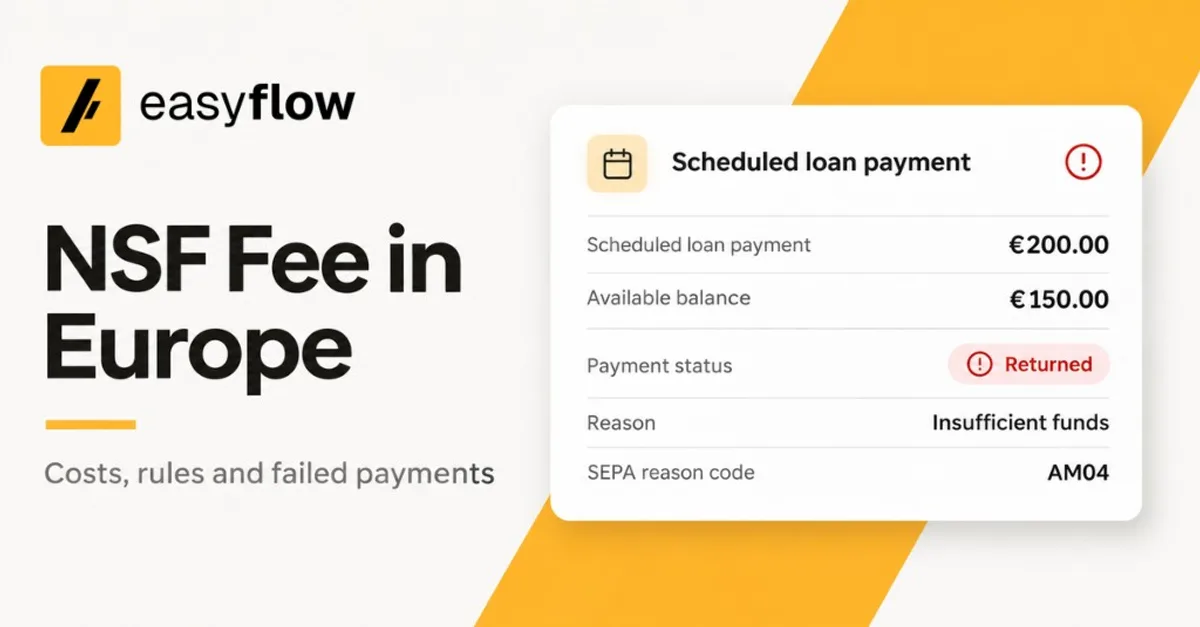
An NSF fee, or non-sufficient funds fee, is a charge a bank may apply when it rejects or returns a payment because the account does not have enough available money. The recipient does not ultimately receive the payment, so the bill or loan instalment may still be due. Depending on the agreement and applicable law, the recipient may also charge a separate fee.
“NSF fee” is a term commonly used in North America. In Europe, you are more likely to see unpaid transaction fee, returned Direct Debit fee or, in France, frais de rejet de prélèvement.
The wording matters when you check your statement, but the practical question is the same: what happened to the payment, and what do you need to do next?
NSF Fee vs. Overdraft Fee
A returned-payment fee and an overdraft charge arise from different outcomes.
| Question | NSF or returned-payment fee | Overdraft cost |
|---|---|---|
| What happens to the payment? | The bank rejects it or returns it unpaid. | The bank allows the payment to go through, even though the account does not have enough available funds. |
| Does the recipient get paid? | Not ultimately, if the payment is returned. | Generally, yes. |
| What happens to the account? | The rejected payment itself does not create an overdraft. A fee or another transaction could still make the balance negative. | The payment can take the account into an arranged or unarranged overdraft. |
| What might the bank charge? | An unpaid-item or returned-payment fee, if the bank applies one. | Interest or other permitted charges, depending on the account and local rules. |
| What happens to the loan instalment? | It remains due unless the lender receives payment another way. | The lender has generally received the payment, but the borrower may now owe the bank for the overdraft. |
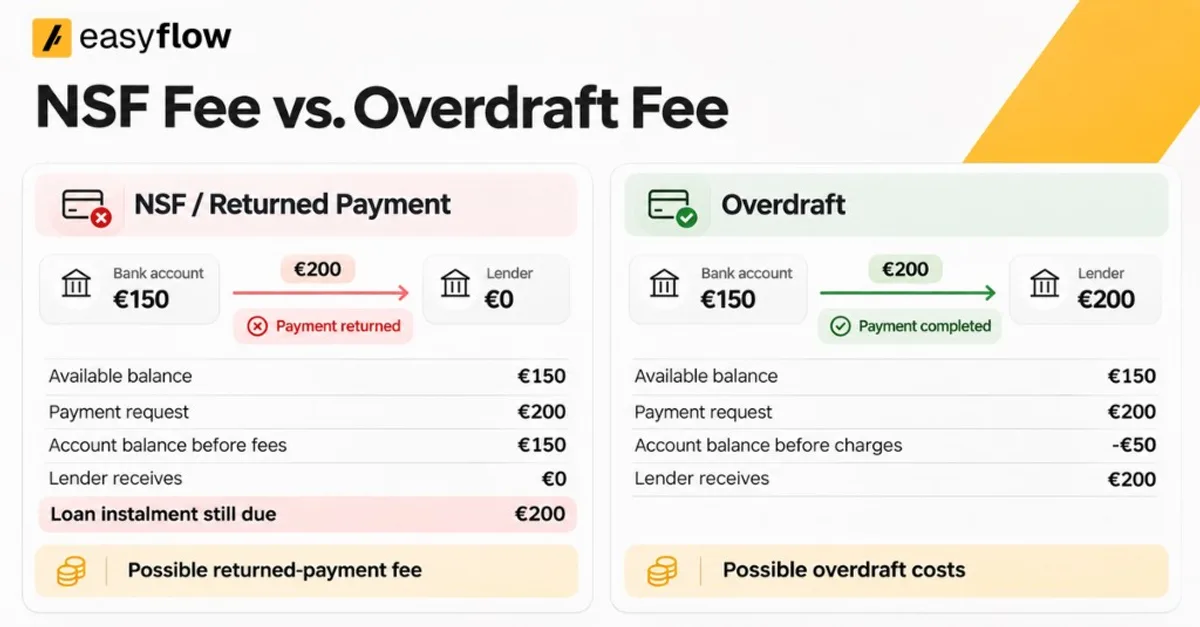
A bank does not have to charge a fee in either situation. Some accounts do not charge for unpaid items; others may charge interest for an overdraft rather than a fixed fee.
Typical Costs and Rules
There is no single NSF fee for Europe. Charges depend on the country, the account provider, the type of payment and the terms of the account.
The examples below are useful starting points, not market averages. They were checked on 25 November 2026.
| Market or provider | Published example | What it means |
|---|---|---|
| France: personal banking | For a rejected transfer or direct debit, the general bank-fee cap is the lower of €20 or the amount of the rejected payment. [1] | This is a limit on the relevant bank charge, not a universal cap on every charge a lender might seek to apply. |
| Germany: N26 | N26 lists a €3 fee for a direct debit rejected for insufficient funds on accounts opened in Germany. [2] | This is one provider’s published tariff, not a German market average. |
| UK: NatWest | NatWest lists a £1.55 unpaid transaction fee when it returns a transaction unpaid. Its published support page also describes a monthly charging cap. [3] | Check the terms for your account; other UK providers can have different policies. |
French public guidance says that if the same transfer or direct debit is rejected again, the bank should not charge another rejection fee; if it does, it must refund it. The guidance also says the bank must inform the customer of payment-incident charges at least 14 days before taking them from the account. Additional protections can apply to customers in financial difficulty. [1]
N26’s tariff depends on where the account was opened and, in some cases, its IBAN. NatWest’s published fee and account conditions should likewise be checked before relying on the example. [2] [3]
Can the same payment trigger more than one charge?
It can, depending on where you bank and which charges are involved.
A lender or another creditor may try to collect an unpaid payment again. Whether the bank can charge for another failed attempt depends on local rules and the account agreement. France’s rule above is one example; it should not be assumed to apply throughout Europe.
There may also be charges from different parties:
- Your bank may charge for returning the payment.
- The lender or merchant may seek a returned-payment or late fee, where permitted by the agreement and applicable law.
- The lender’s payment provider may charge the lender for the failed transaction. That does not automatically mean the lender can pass the charge on to you.
The original amount remains important: if a €200 loan instalment fails, a €10 bank fee does not replace the €200 payment.
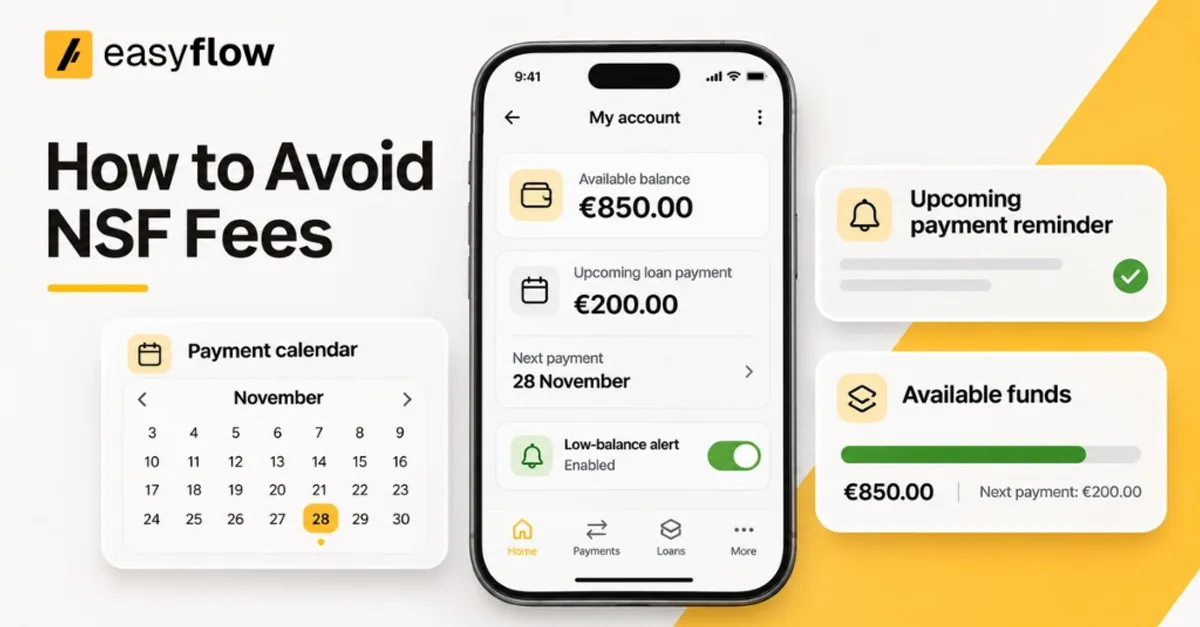
How to Avoid NSF Fees
The most effective precautions address both the balance in the account and the timing of the payment.
01
Check your available balance before scheduled payments
The balance shown in an app may differ from the amount available to spend because of pending transactions, card holds or deposits that have not cleared.
02
Keep track of recurring debits
Loan instalments, rent, subscriptions and insurance payments can arrive close together. Check their collection dates, particularly around weekends and public holidays.
03
Set a low-balance alert
If your bank offers one, choose a threshold that gives you time to act before a large scheduled payment.
04
Keep a buffer where possible
A small reserve can absorb timing differences between incoming income and outgoing bills. The right amount depends on your circumstances; it is not a fixed figure that works for everyone.
05
Ask to move a payment date
If an instalment regularly falls just before payday, ask the lender whether another date is available. Get confirmation before assuming the schedule has changed.
06
Review backup options carefully
A linked savings account or arranged overdraft may help in some cases, but availability, transfer charges and interest vary. An overdraft is borrowing, even if it prevents a payment from being returned.
07
Contact the lender early if you expect difficulty
Ask about a revised date, an alternative payment method or support options before the payment fails.
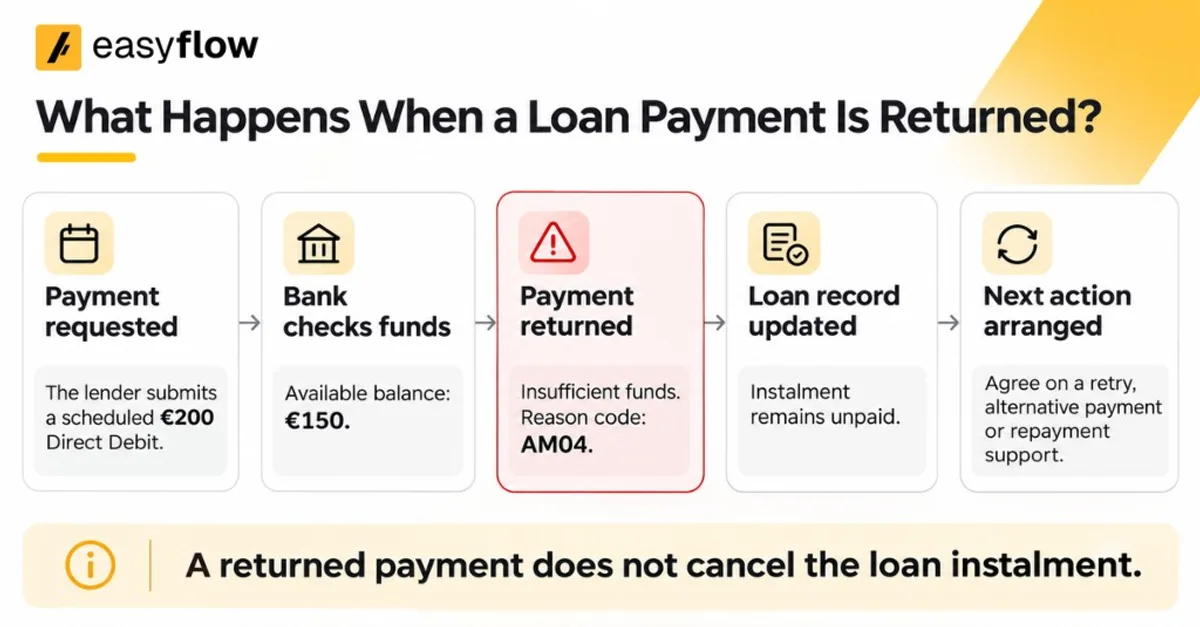
What Happens When a Loan Payment Is Returned?
A failed loan payment involves more than one account and often more than one organisation.
01
The lender requests the payment
For a Direct Debit, the lender or its payment provider submits a collection against the borrower’s account.
02
The bank checks whether it can pay
If there are insufficient available funds and the bank does not cover the payment, it may reject or return it.
03
The lender receives a payment-status update
The timing and detail depend on the payment method and provider. A return can arrive after an earlier processing or settlement event.
04
The lender updates the loan record
If the instalment was previously shown as paid, the return needs to be reflected in the loan balance and repayment history.
05
The borrower and lender arrange the next step
Depending on the reason for failure and the applicable rules, this could mean another collection, a bank transfer, updated account details or a conversation about repayment difficulties.
An example
Imagine a borrower has a €200 loan instalment due and only €150 available. The bank returns the debit unpaid.
For illustration, suppose the bank charges €10 and the lender is entitled to charge a separate €5 under the relevant agreement and law:
| Item | Amount |
|---|---|
| Original instalment still due | €200 |
| Bank’s returned-payment fee | €10 |
| Separate lender fee, if applicable | €5 |
| Total cost associated with the instalment | €215 |
If the bank deducts its fee from the borrower’s account, that charge is paid to the bank; it is not a payment towards the loan.
SEPA Direct Debit: Why the Reason Code Matters
For euro-denominated Direct Debits processed through SEPA, payment providers can receive an exception message known as an R-transaction. The European Payments Council distinguishes several types, including rejects, returns, refunds, refusals and reversals. They describe different events, so they should not all be treated as “insufficient funds.” [4]
Common reason codes include:
| Code | Meaning | Sensible next step |
|---|---|---|
| AM04 | Insufficient funds. | Contact the borrower and agree on a suitable next step before another collection. |
| AC04 | The account is closed. | Request updated payment details; a retry against the same closed account will not solve the problem. |
| MD01 | No valid mandate, or an unauthorised transaction in the relevant message context. | Check the mandate and the type of message before taking further action. |
| MS03 | Reason not specified. | Investigate with the payment provider or borrower; do not assume the account lacked funds. |
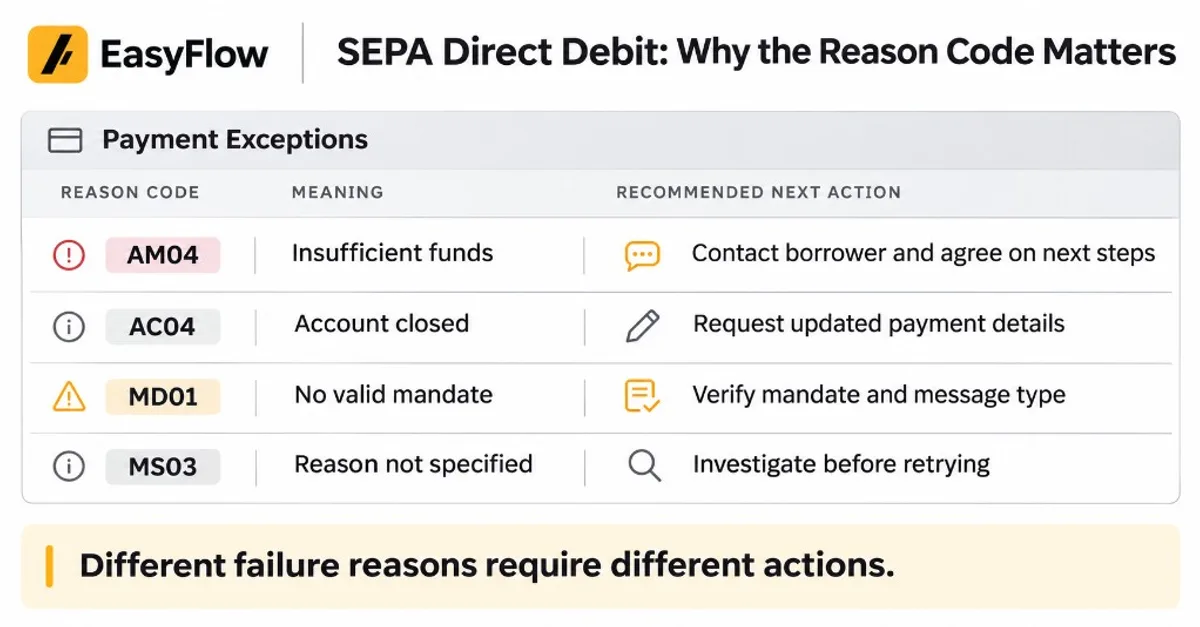
The EPC notes that data-protection restrictions can prevent a more specific code from being used in certain countries. An unspecified code may therefore conceal several possible underlying reasons. [5]
A note on the UK
The UK is within the geographical scope of SEPA, but that does not make every UK Direct Debit a SEPA payment. SEPA Direct Debits are made in euros; domestic UK Direct Debits can run through the separate Bacs system. The relevant payment scheme and its rules need to be identified before interpreting a failure. [6] [7] [8]
What Should You Do After a Failed Payment?
If a loan payment has been returned, act on the payment itself before focusing only on the fee.
01
Confirm the status
Check your bank account and ask the lender whether the instalment was received, rejected, returned or is still being processed.
02
Find out whether another collection is planned
Ask for the amount and date of any retry.
03
Agree on one way to pay
If you make a manual transfer while another debit is already in progress, both payments could be collected. Ask the lender how to prevent or resolve a duplicate.
04
Check the charges
Compare the bank’s fee with its tariff and applicable local rules. Ask the lender to explain any separate charge.
05
Keep the evidence
Save the payment reference, bank notification, correspondence and confirmation of any replacement payment.
06
Ask for help if the problem will continue
A one-off timing problem and an ongoing affordability problem call for different solutions. Tell the lender which situation you are facing.
If you think a bank fee is incorrect, ask the bank to review it. If the lender charged a separate fee, raise that part with the lender. A waiver may be available, but it is not automatic.
Can a Failed Payment Affect Your Credit History?
A returned debit and a reported missed loan payment are not the same thing.
A payment failure may be resolved quickly. If the instalment remains unpaid, however, the loan can become overdue, and the lender may report arrears where local reporting rules and its practices require or allow it. The timing and consequences vary by country and lender.
For example, UK credit reference agency Experian notes that missed payments can affect a credit score. That does not mean every failed debit immediately becomes a reported missed payment. [9]
Ask the lender:
- When will the instalment be considered overdue?
- Is there a grace period?
- When, if at all, would arrears be reported?
- Will a replacement payment update the loan record, and when?
How Lenders Can Handle Failed Payments More Carefully
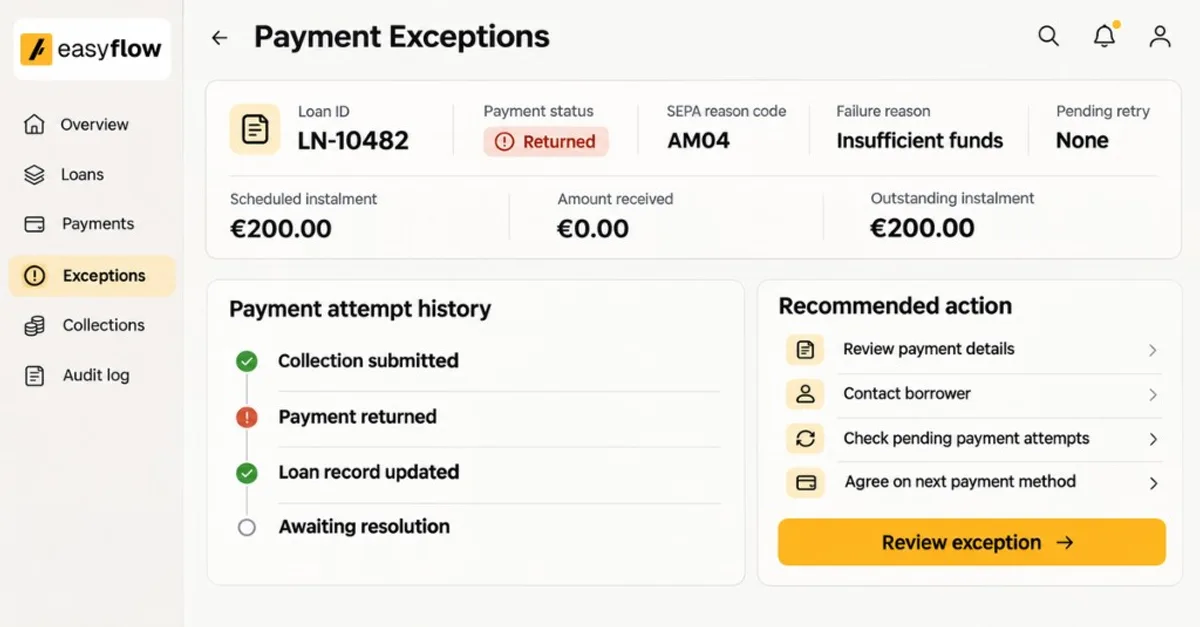
For a lender, a failed debit creates an operational problem: the payment provider, loan ledger and collections team may each hold part of the story.
A sound workflow should be able to answer five questions:
01
Which instalment was being collected?
Keep the obligation distinct from each payment attempt. One instalment may have an original debit, a retry and a manual payment.
02
What did the payment provider actually report?
Store the original status, reason code, reference and timestamp. Avoid replacing a specific bank message with a generic “failed” label.
03
Has money already been credited to the loan?
If a later return reverses an earlier payment, update the loan record without erasing the original transaction history.
04
Is another payment in progress?
Before retrying, check for pending attempts and alternative payments. Build a process for handling a manual payment that arrives while a debit can no longer be stopped.
05
Is a retry appropriate?
Check the reason code, mandate status, payment-provider requirements, borrower communication and applicable local rules. A closed account or disputed mandate calls for a different response from a confirmed temporary shortfall.
A useful measurement is the first-attempt return rate: the number of first collection attempts later rejected or returned, divided by the number of first attempts presented for the same cohort. Give the cohort enough time for returns to arrive before comparing periods; otherwise, recent payments may appear more successful simply because their return messages have not yet arrived.
Frequently Asked Questions
What does NSF stand for?
NSF stands for non-sufficient funds. It means there was not enough available money to cover a requested payment.
Is an NSF fee the same as an overdraft fee?
No. An NSF or returned-payment fee relates to a payment the bank does not ultimately pay. An overdraft cost relates to borrowing that can arise when the bank allows a payment to take the account below the available balance.
Do European banks charge NSF fees?
Some charge for unpaid or returned payments, although they may use different terminology. The amount and rules depend on the country, bank, account and payment type.
Is there one maximum NSF fee across Europe?
There is no single fee amount that applies to every European bank account. National rules can set limits for particular charges. France, for example, limits the relevant bank fee for a rejected transfer or direct debit to the lower of €20 or the payment amount under the general rule.
Will a failed Direct Debit be taken again automatically?
Not necessarily. A creditor may arrange another collection, but timing and procedure vary. Ask the lender or merchant whether a retry is planned before making a separate payment.
Can a lender charge a fee as well as my bank?
A lender may seek a separate fee if the agreement and applicable law permit it. The bank’s fee and the lender’s fee are different charges, so ask each organisation to explain its own amount.
Does cancelling a Direct Debit cancel the loan?
No. Cancelling the payment instruction does not cancel the underlying loan agreement. Contact the lender to arrange another way to pay. [10]
What if I do not recognise a Direct Debit?
Contact your bank and the named creditor promptly. A disputed or unauthorised debit requires a different response from a payment that failed because of insufficient funds.
For SEPA Direct Debit Core, the EPC describes an eight-week period in which a payer can request a refund for an authorised collection without giving a reason, and up to 13 months to request a refund for an unauthorised collection. The applicable scheme and circumstances matter. [6]
Can I ask for a returned-payment fee to be refunded?
Yes. Contact the organisation that charged it, explain why you believe it is wrong and provide the relevant references. Whether a refund is required, or offered as a goodwill gesture, depends on the circumstances and applicable rules.
Conclusion
An NSF fee is only one possible consequence of a failed payment. The more urgent issue is whether the lender, landlord or other recipient has actually been paid.
For borrowers, the next step is to confirm the payment status, avoid an accidental duplicate and check each charge with the organisation that applied it. For lenders, it is to connect the payment result to the correct instalment and respond to the reason for failure, not merely to the word “failed.”
Let's talk lending
Ready to take your lending business to the next level?
See how EasyFlow can support your lending products, automate your workflows, and simplify your operations. Book a personalised demo and discover what the platform can do for your business.
A live walkthrough tailored to your business needs.